This diagram was created using a “risk register” spreadsheet containing 400+ identified risks from developing an autonomy architecture.
Each risk was scored:
- on the x-axis with a score for the importance of implementing a solution (1 = minor importance, 2 = of some importance 3 = very important, 4 = extremely important). A higher score deems the risk to be very likely to occur and very likely to have a high impact on the telco
- on the y-axis with a score for the difficulty of implementing a solution (1 = easy, 2 = moderately difficult, 3 extremely difficult). Factors impacting this score included whether a technical solution was known to be available today or whether the solution was just a new version of a solution already in place (e.g. an additional set of new governance processes)
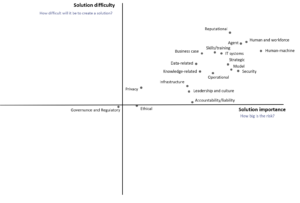
Looking at the trends in the diagram
- When creating the risk register, it was noted that all risks have a potential resolution (although, some of the more technical solutions are only in very early production or still in academia, so these resolutions are probably best described as “theoretical”)
- Many of these risks are related to the significant gen AI innovation seen in the last few years, and 30% of all risk mitigation activities in the spreadsheet are related to enabling these models to operate in a safe, trustworthy, and reliable manner
- It was generally noted that many risks can be addressed by putting “something new” in place. This might be a new process or an information source. These requirements appear not too costly or difficult, but there is a significant number of individual actions to be completed
