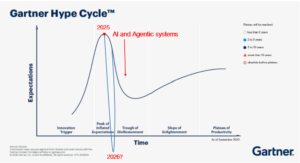
AI is heading down the hype curve. Keep your nerve.
Having owned a few dots on Gartner hype cycles over the years, I recognise this moment.
Your “AI and agentic systems” dot has passed the peak, and the voices of doom are starting to drown out the tech-bro marketing frenzy.
The temptation is to push your dot straight into the depths of the trough. Nobody wants to look naïve. But move too quickly and you have nowhere to go next year, when everyone discovers that building robust systems is going to take a couple of years. The “powers that be” won’t let you quietly sneak your dot back up the curve.
What you need is a steady nerve – and a modest shove down the slope.
What does this look like on the ground?
Telcos and vendors face a chasm between successful pilots and agentic systems that work reliably at scale. To understand what it takes to cross, I have been building a risk register. It now runs to just over 400 rows, and a few themes stand out:
What should telcos and vendors be doing now?
Build a longer-term vision you can explain. In a recent paper for Netcracker, Scaling agentic AI, I set out a five-stage process for crossing this gap. Developing—and being able to articulate—the bigger plan feels particularly important now
Create your own risk register—and give someone ownership. Managing risk stretches well beyond a decent agent harness and some additional governance. Track the risks, the proposed remedies and progress towards resolving them, with a senior owner accountable for keeping the whole picture in view.
(If my risk register would help you get started, a copy is available for $500. Email charlotte@charlottepatrick.uk for details)
Focus on the knowledge plane. My current research explores the knowledge, context and memory that agents need to work effectively. For now, I have more questions than answers:
I hope to bring you some early answers in the next newsletter.
Make architectural decisions that support Minimum Viable Intelligence. I coined this term last year to describe a simple principle: use only as much intelligence—AI, machine learning or analytics—as the problem requires. This question is attracting attention this month: from approaches such as Jev, designed to make fast, simple decisions, to Gartner’s Inference Paradox: cheaper tokens do not necessarily mean cheaper agentic workflows as systems become more complex.
My expectation is that it will take another six months or so for this industry attention to translate into workable new models and other techniques that deliver value for telcos. Hopefully, their appearance will dovetail nicely with the telco knowledge plane being ready to supply the context they need.
Work out where the money is. This is the difficult bit. My previous research suggests that around two-thirds of the potential financial value from applying AI, automation and agents to the network could be captured through automation without AI or agents. That leaves a smaller pool of additional value against which to justify the cost of agentic deployments. I plan to spend the fourth quarter with my spreadsheets—and talking to telcos and vendors—looking for use cases already generating value, alongside credible new opportunities. These will feed into my financial modelling, with the aim of producing a heatmap of telco value opportunities by the end of the year.
My working assumption remains that agentic systems will account for around one-third of the total potential financial value. I have yet to see enough evidence that greater autonomy will unlock substantial new telco service revenues to raise that estimate.
