I have recently finished a competitive landscape document working with Caroline Chappell at Cambridge AIQ.
We interviewed 13 large and small vendors providing network assurance to telcos; asking them questions about their product set around agentic systems and AI.
We found:
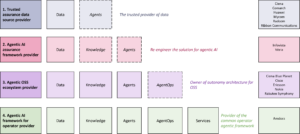
Four main vendor strategies were seen:
The first category is the trusted assurance data source providers. These are assurance specialists seeking to protect their role as key providers of network data by adding agentic AI interfaces. They aim to provide trustworthy, high-quality data supported by many years of experience in normalization and federation. In addition, they have traditionally built semantic understanding into their applications, but as agentic AI starts to require development of a knowledge plane, they are the least likely of the four categories to consider developing their own knowledge assets (e.g. knowledge graphs). They also have fewer agents already developed than other categories, and we may see them provide one or more data agents that operator- or vendor-owned agents providing assurance capabilities such as root-cause analysis can query.
Agentic AI assurance framework providers are assurance specialists that we see comprehensively re-engineering their solutions for agentic AI. Only two vendors are in this category: Infovista and Vitria, each taking a different approach. Vitria’s agents operate in a streaming, real-time AIOps pipeline, with a knowledge plane serving as the agents’ grounding. While Infovista offers an extensive portfolio of agents that help customers retrieve the right data for their purposes, it does not currently offer a full knowledge plane.
Agentic OSS ecosystem providers have a full OSS portfolio (including inventory and orchestration) and are tightly integrating agentic AI to become the full-stack autonomy architecture for network operations. They are more likely to adopt a “data + knowledge” strategy, adding to their comprehensive data assets by building an equally comprehensive set of knowledge assets. In general, these vendors tend to have more sophisticated product sets, with more agents and more mature digital twin implementations. Some also offer AgentOps and development capabilities; some do not.
The final category, the Agentic AI framework for operator providers, has a broad telecoms portfolio across network domains, including BSS and/or network functions, cloud platforms, and security. They wish to provide a common agentic AI framework and accompanying professional services that leverage their operator expertise. We interviewed Amdocs in this category, which sees agentic AI as central to the company’s future. It offers multiple agents, a knowledge plane with digital twin, a common logical data model across operational and analytical domains, a full governance, security and observability framework, and an SDK.