Today’s fragmentation in the agentic world is, frankly, unacceptable!
I fall into a subset of industry analysts who like to dig down into the details of a topic.
The rise of AI and agentic systems has challenged me ….
I love a nice, organized set of stored information that I can augment over time. However, so many topics are being discussed at once that they’re straining my storage systems!
On top of this, there has been a sudden rise in new terminology: harness, control plane, bounded autonomy etc. On the one hand, marketers are going to “market” and I can’t stop the flood of new terminologies that give articulation to each vendor’s particular package of capabilities.
On the other, I can grumble … “that definition of a “harness” is not how OpenAI originally defined it!”
How to grasp the big picture?
This is one of my current interest areas.
My contention is that, to deal with the proliferation of these marketing terms, a well-prepared telco needs to understand the broader topics that sit underneath them; and have a solid plan for managing the associated risks within each topic.
To help clients with this, I have just finished a research note outlining a roadmap that moves telcos from pilots to more scaled agentic systems. Underneath the research is a (very large) spreadsheet which attempts to understand the technical (and related) capabilities needed to move the telco into the world of scaled agentic systems.
This spreadsheet is divided into layers of what I describe as my “autonomy architecture”. Each layer outlines a different set of technologies needed to move a telco towards autonomy. The diagram below describes the technologies within the “operations layer”, which sits towards the bottom of the layers. This layer includes all tools for lifecycle management of the autonomy architecture, including agents, models, knowledge, and data. It also includes a typical set of tools to manage software systems: observability, testing, monitoring, security etc.
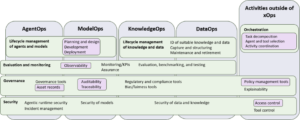
The diagram uses a combination of colors to describe 3 “views” of this layer:
What should telcos be doing to grasp this big picture for themselves?
I have a risk register and other information to help someone with this task, please reach out to me: charlotte@charlottepatrick.uk.
Would you be interested in taking part in my next research project?
I hope to conduct several in-depth interviews with more sophisticated telcos, then survey a broader cohort with short interviews/surveys about their risk management activities. Questions will include:
It would be great to have you take part if you are interested. Please reach out: charlotte@charlottepatrick.uk.
